
Compare two jobs
Is the new job worth it after tax?
Put your pay now next to a promotion or an offer from another employer, and see what really changes: your take-home, your pension and the whole package, for the 2026/27 tax year.
Today
Your job now
Taxed like salary, and it does not count towards the pension.
A promotion or an offer
The new job
No allowance, pension or bonus
Counted in your first year only.
About you, the same for both jobs
Scottish rates follow where you live, not where the employer is, so this applies to both jobs.
Enter both salaries to see what the new job changes. No pension or student loan is assumed.
How the comparison works
Two jobs, one of you
The salary, an allowance, the pension, what the employer adds and any bonus belong to each job. Your student loan and where you live are the same for both, so you set them once.
A month is what arrives monthly
Salary and an allowance are in the monthly figure. A bonus is not: it lands in one month, so it counts in the year instead. Pensions are worked out on salary alone.
The whole package
An offer with a lower salary and a bigger employer pension can still be the better deal. Take-home and pension, added together, show it.
What this counts, and what it leaves out
Counted
- Salary, and a cash or car allowance
- What you pay into the pension, and how it is taken
- What the employer puts in
- A yearly bonus, in pounds or as a percentage
- A one-off payment for joining, in the first year
- Income Tax, National Insurance, student and postgraduate loans
- Scotland, and the tax year
Not counted
- A company car, which is taxed as a benefit rather than as pay
- Medical cover, life cover and other benefits in kind
- Shares and share options
- A tax code other than the standard one
- Marriage Allowance, and the High Income Child Benefit Charge
- A move across the Scottish border, which changes the rates you pay
- The commute, holiday, sick pay and notice periods
- Employer National Insurance, which never reaches you
One assumption is worth stating plainly: an allowance is treated as ordinary pay, so it is taxed like salary and it builds no pension, which is how most schemes define pensionable pay. If yours counts it, put it in the salary box instead.
One thing left out can outweigh everything here. If you claim Child Benefit and either job pays more than £60,000, the High Income Child Benefit Charge takes part of it back, and all of it by £80,000. The calculator counts it, one job at a time.
An example: the salary is not the whole answer
Say you earn £52,000 today, paying 5% into the pension while your employer adds 4%. The offer is £55,000 with a £5,400 car allowance, the same 5% from you, and 3% from them.
- Take-home
- £409 a month more
- Into the pension
- £280 a year less
- The package
- £4,627 a year more
The salary rose by £3,000, but the allowance is what moves the monthly figure, and because it is not pensionable, less goes into the pot than before. Whether that is the better job is yours to decide. The point is that the salary alone would not have told you.
Questions people ask
Is a car allowance taxed the same as salary?
Yes. A cash or car allowance is ordinary pay: Income Tax and National Insurance come off it at the same rates as your salary, and it arrives every month, so it is in the monthly figure here. A company car is different. That is a benefit in kind, taxed on a value HMRC sets from the car's list price and emissions, and this page does not cover it.
Does a car allowance count towards my pension?
In most schemes, no: pensionable pay is basic salary, so an allowance builds no pension. That is the assumption here, and it is why moving pay out of salary and into an allowance can leave your take-home almost unchanged while less goes into the pot. If your scheme does count it, add it to the salary instead of the allowance box.
How is a payment for joining taxed, and why is it not in the monthly figure?
It is taxed as pay in the year you get it, which is why it can push that year into a higher band on its own. It is a one-off, so it belongs to your first year and nowhere else: spreading it over twelve months would invent a monthly figure no month ever pays. The card for it shows what it leaves after tax, and what every year after your first takes home.
Can I compare a job in Scotland with one in England?
Not on this page, and for most people it makes no difference. Scottish Income Tax follows where you live, not where the employer is, so taking a job with a Scottish employer while living in England still leaves you on the rest of the UK rates. The switch here is about you, so it applies to both jobs. If the new job means moving across the border, work each salary out on its own in the calculator, ticking Scotland only for the one that would be taxed there.
Should I compare the monthly figure or the yearly one?
The monthly figure is what changes in your account each month, so it is the one to weigh against rent, a mortgage or childcare. The yearly figure adds anything that arrives once, like a bonus. If the two jobs differ mostly in bonus, the yearly figure is the fairer comparison.
Is a bigger employer pension worth a lower salary?
It can be. Money the employer puts in is part of what the job pays you, it just arrives in the pension rather than the account, and this page adds the two together as the package. What it cannot tell you is when you need the money: a pension is not reachable until 55, rising to 57 in 2028.
See take-home pay on every job listing
myTakeHome for Chrome shows your real salary directly on Indeed, LinkedIn, Reed, and more.
Add to Chrome · Free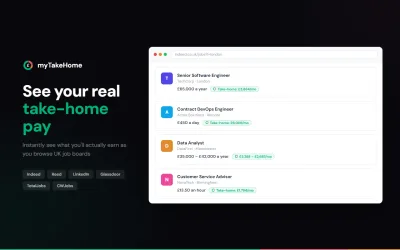
Every figure here is worked out from the 2026/27 HMRC rates by the same engine as the calculator, with the Personal Allowance at £12,570. Those rates are compared with GOV.UK every week, last matched on 14 September 2026: how myTakeHome calculates. For one salary in full, with a payslip, tax bands and a bonus month, use the take-home pay calculator.